
Property Firebreak Planning Guide for Rural NSW
A firebreak that looks tidy from the driveway can still leave the house, stock yards or access track exposed. The real value of a property firebreak planning guide is not simply deciding where to clear a strip of ground. It is working out how fire, smoke, machinery, people and livestock will move across your block on a bad fire-weather day.
For rural and acreage properties, a useful plan joins up vegetation management, access, drainage, fencing and the space needed for firefighting vehicles. The right approach depends on your terrain, vegetation type, property use and local requirements. A cleared line without safe access or ongoing maintenance is rarely enough.
Start your property firebreak planning guide with the whole block
Before machinery arrives, walk or drive the property and look at it as a connected system. Mark the home, sheds, water tanks, stock yards, dams, internal tracks, boundary fences, gates and neighbouring vegetation. Identify the areas where grass, leaf litter, fallen timber, lantana, regrowth or dense scrub build up fastest.
Then consider where a fire is most likely to approach from. On many NSW properties, this is not the closest boundary. A slope carrying scrub uphill towards a house, a creek line full of fuel, or an unmanaged neighbouring paddock may present a greater risk than open grazing land beside the road.
Pay close attention to terrain. Fire can move quickly uphill, while gullies can funnel wind and carry embers. A firebreak placed at the top of a slope may be more useful than one cut lower down, but it must still be reachable and safe to maintain. On wet or erosion-prone ground, extensive bare-earth clearing may create a drainage problem that causes more work later.
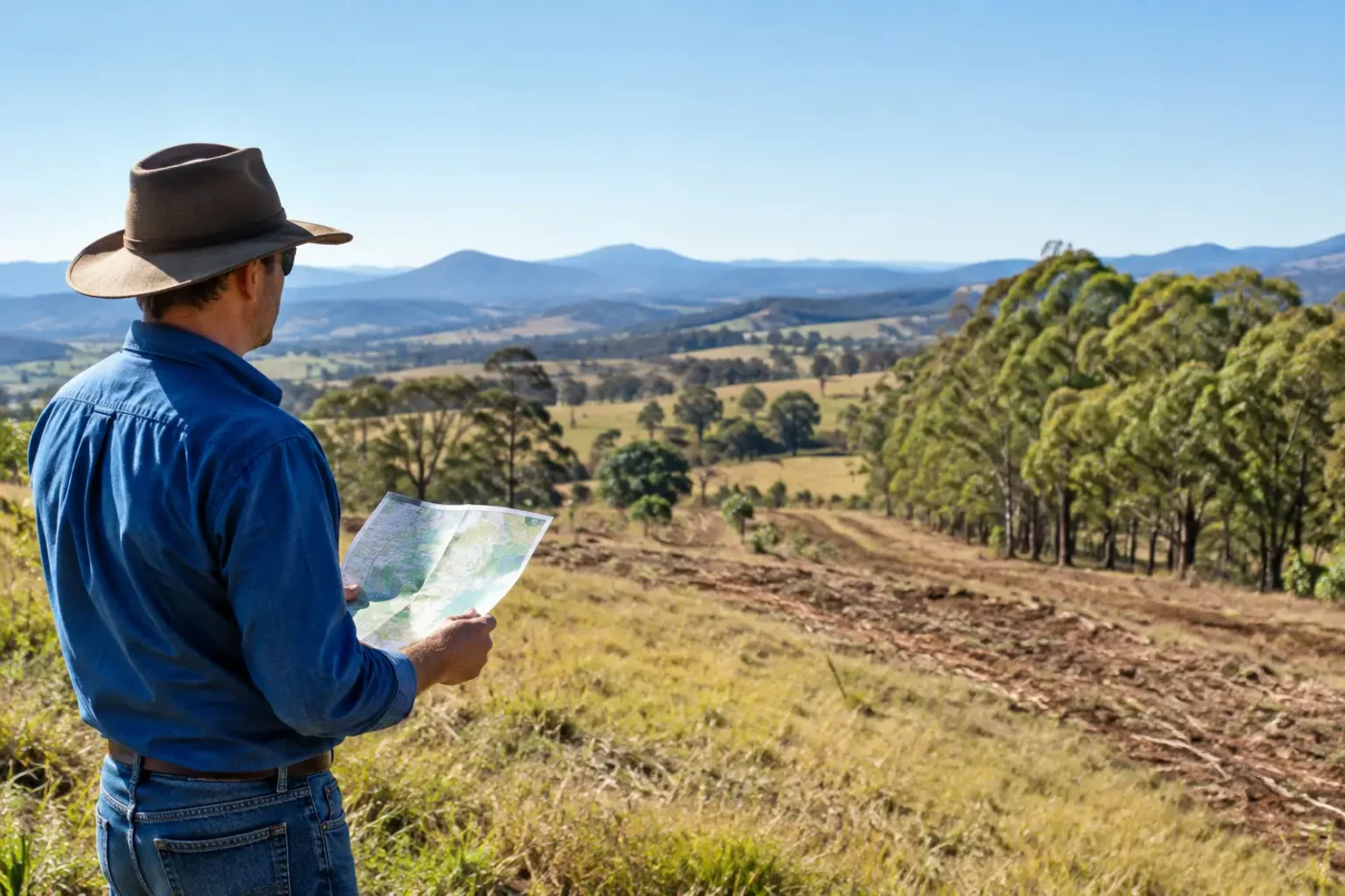
A simple property map helps turn observations into a workable scope. It does not need to be complicated. Show boundaries, contours or steep areas, existing tracks, buildings, water points, gates and key vegetation zones. This gives contractors, neighbours and family members a clear picture of what the firebreak system is meant to do.
Set clear priorities for each firebreak zone
Not every part of a property needs the same treatment. Planning is more effective when each area has a practical purpose rather than treating all clearing as one job.
Defend buildings and essential infrastructure
The area around a dwelling, machinery shed, workshop, pump, fuel storage, stock yards and water supply should be the first priority. Reduce fine fuels such as dry grass, leaf litter, low branches and dense garden planting. Keep combustible materials away from structures, and make sure gates, driveways and turning areas are not blocked by overgrowth.
This does not always mean stripping the ground bare. Well-managed grass, spaced trees and low-fuel surfaces can be more stable and easier to maintain than exposed soil. The right balance protects assets while preserving shade, ground cover and the character of the property.
Create access that works under pressure
Firebreaks and access tracks often overlap, but they are not exactly the same thing. A machine may be able to travel along a narrow track in dry conditions, while a fire truck needs enough width, clearance, surface strength and turning room to enter and leave safely.
Check low branches, unstable edges, washouts, tight corners and gates that are difficult to open. If a track crosses a drainage line, assess whether culverts, hardening or reshaping are needed. A clear access route to the house, water source and major paddocks can be as valuable as a cleared boundary line.
Protect boundaries, fences and neighbours
Boundary firebreaks can help reduce fuel continuity and protect fencing, especially where grass, scrub or forestry vegetation meets your land. They also make it easier to inspect fences and control regrowth. However, avoid pushing vegetation or debris into a neighbour’s paddock, creek line or roadside reserve.
Plan the work with fence lines in mind. Heat, falling limbs and machinery can damage old posts, wire and gates. In some cases, it makes sense to repair or replace a vulnerable fence after clearing, when the line is accessible and the final firebreak width is confirmed.
Choose the right vegetation treatment
The best firebreak is usually built from several treatments, not one method used everywhere. Slashing may suit open grassland. Forestry mulching can reduce scrub, saplings and woody regrowth without the need to burn heaps. Selective clearing may be needed around tracks, fence lines and buildings, while targeted weed control can slow regrowth after mechanical work.
Forestry mulching is particularly useful where dense vegetation needs to be broken down while retaining material on site as mulch. It can reduce the ladder fuels that allow fire to climb from grass into shrubs and tree canopies. But mulch is still organic material, so the finished surface needs to be assessed and maintained rather than assumed to be fireproof.
Bare-earth breaks can be appropriate in some locations, particularly where a mineral-earth barrier is required and soil conditions allow it. They can also create dust, erosion and weed issues if they are too wide, poorly drained or left exposed before heavy rain. On grazing land, a closely managed low-fuel grass strip may be more practical over the long term.
Avoid treating mature trees as the only problem. Fine fuel is often the bigger issue. Dry grass, bark, leaf litter, small branches and low shrubs ignite readily and carry fire quickly. Removing a few large trees while leaving a heavy grass and litter load underneath does little to improve the overall fuel picture.
Plan for water, gates and turning space
A firebreak plan should make it easier for people to act, not just create a line on a map. Make sure water points can be reached safely and that pumps, tanks, dams or static water supplies are clearly known to those who may need them. Keep access to them free of parked machinery, stored materials and fallen branches.
Check that gates are wide enough and positioned sensibly for larger vehicles. A narrow entrance followed by a sharp turn, soft shoulder or steep climb can limit access when it matters. Where practical, provide a turnaround area so a vehicle does not have to reverse a long distance through smoke or uneven ground.
If livestock are part of the operation, include stock movement in the plan. Identify paddocks with lower fuel loads, reliable water and safe entry points. There may not be time to move animals during an emergency, but knowing which gates and laneways offer the safest option prevents rushed decisions.
Check approvals and avoid creating new risks
Firebreak work can involve vegetation clearing, earthmoving, burning, drainage changes and work near roads or waterways. Requirements vary between councils, Local Land Services areas, planning controls and vegetation types. Bush fire prone land may also have specific planning and construction considerations.
Before clearing, confirm what applies to your block and whether approvals, exemptions or notifications are needed. This is especially relevant for native vegetation, riparian areas, threatened species habitat, roadside edges and steep ground. If you are planning pile burns, follow current NSW fire permit requirements and weather restrictions rather than treating burning as a quick clean-up option.
Think about electrical and underground services as well. Overhead powerlines need proper clearance, while buried pipes, cables and irrigation lines can be damaged during grading, mulching or excavation. Mark services before any deep work begins.
Build maintenance into the job from day one
A firebreak is not a once-only project. Grass grows, trees drop bark, weeds return and storm damage changes access. The most reliable plans are designed around work that can realistically be kept up through the year.
Schedule inspections before the warmer months, after major storms and following periods of strong growth. Walk the access routes, check gates and look for fallen limbs, washouts, new regrowth and fuel build-up around sheds or pumps. Smaller maintenance jobs completed early are usually safer and more affordable than a major clean-up during a dry spring.
Keep records of what was cleared, treated or repaired, particularly on larger properties or shared boundaries. Photos and a simple map make it easier to plan the next season’s work and explain the layout to contractors, insurers or family members.
For landholders across the Mid North Coast, New England, Hunter and Northern Rivers, planning ahead also means booking practical work before the seasonal rush. A capable crew can combine forestry mulching, vegetation management, track repairs, drainage and fence-line work into one coordinated scope, reducing the need to manage several contractors around the same area.
A well-planned firebreak should leave your property safer, easier to access and simpler to maintain. Start with the places people, livestock and vehicles need to move, then shape the clearing work around those real-world priorities.